
AI music drafts for TV,
from your own library.
Reads the cutEdits your recordings to pictureThe composer decides
See how it works19.7 min
for a 42-minute episode: an editable first draft, every song placed and cut
By hand, an episode like this took our composer a working day.
Meet Cuepup
Your scoring assistant. It reads the cut, suggests where music belongs and edits recordings from your own library to picture. The composer decides; Cuepup keeps a record of those decisions.
How it worksEvery number on this page comes from one TV drama we score, with one composer (up to 29 episodes per test). Internal checks, not a guarantee.
Scene detection
It reads the cut
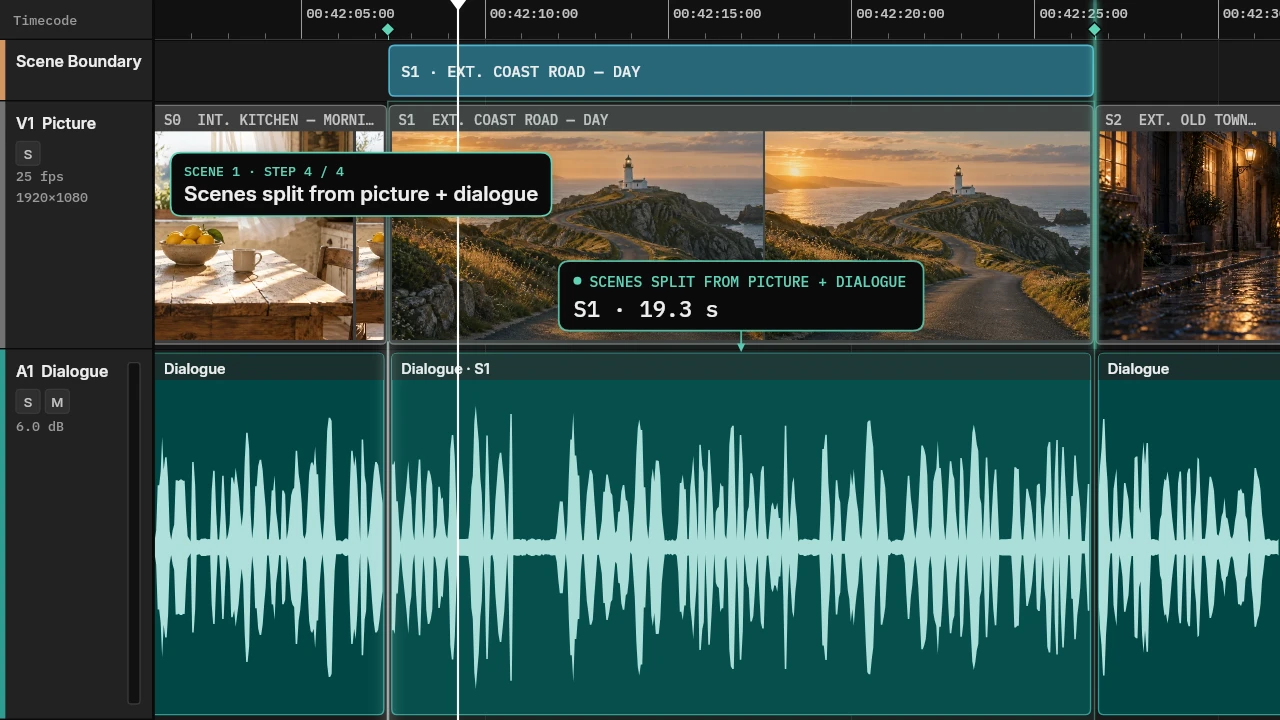
Cuepup watches the picture and listens to the dialogue. It finds where a scene turns and where a line lands, so music has a reason to enter and a place to leave.
91% of the scene breaks it marks match the composer’s It finds 71% of the composer’s breaks 21 episodes
Story analysis
It places each scene in the story
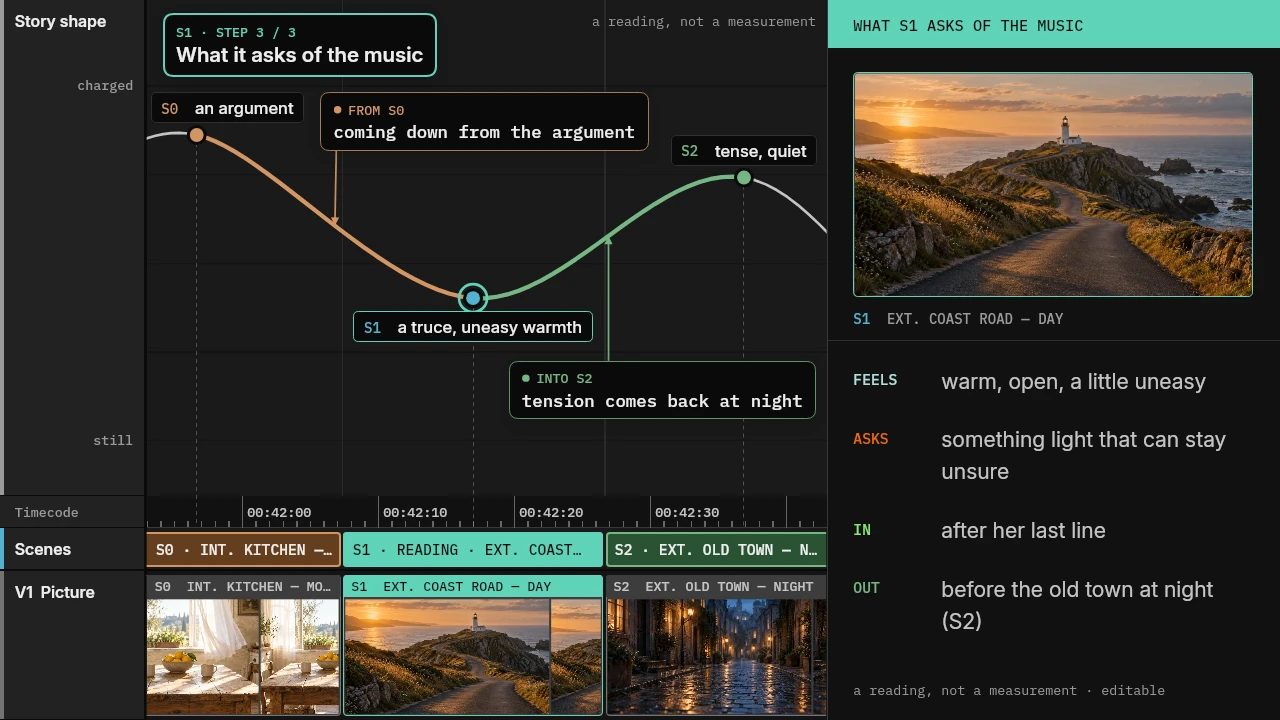
Each scene is read inside the whole episode: what came before, how it feels, what it asks of the music. The result is a short note in plain language that the composer can correct.
82% of regions with a final song used one from the mood family Cuepup picked 778 of 949 regions with a final song 29 episodes
Music editing
It edits your recordings to fit each scene
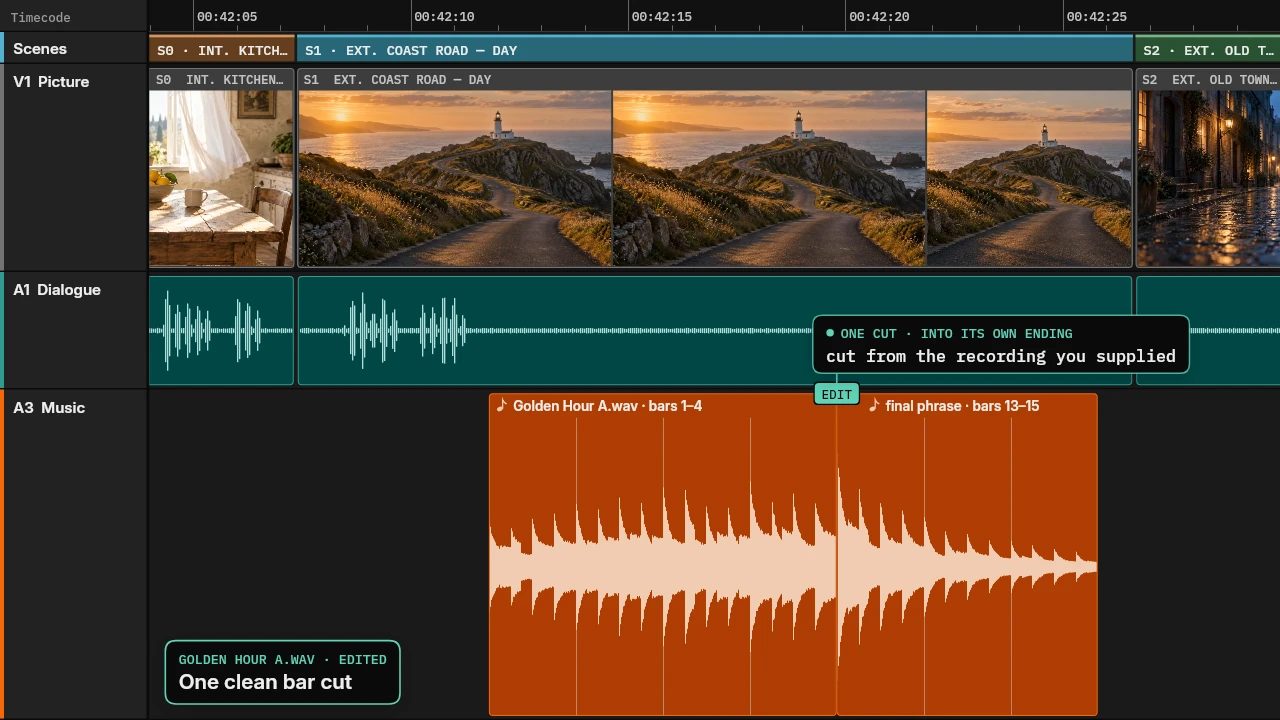
Cuepup maps each recording you supply, its sections, bars and ending, then edits it to the scene: a clean bar cut into the song’s own ending. It never generates a note.
74% of Cuepup cues in the final mix were used exactly as it cut them 494 of 672; 178 were re-edited 29 episodes
Composer review
The composer has the last word
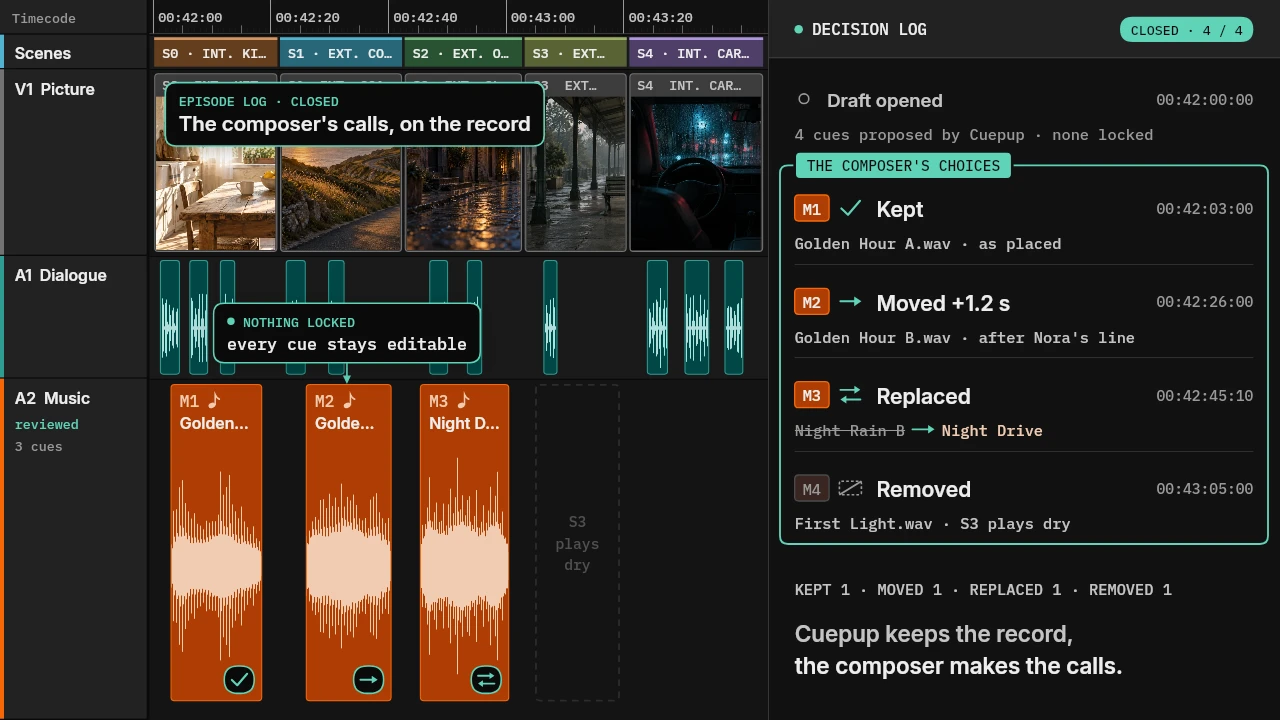
Every draft opens in the Cuepup editor at picture timecode. The composer keeps, moves, replaces or removes each cue; Cuepup never locks a choice.
85% of music regions kept the song Cuepup chose 208 of 244 regions; 67% left exactly as placed Latest 7 episodes
Style learning
It learns the composer’s style
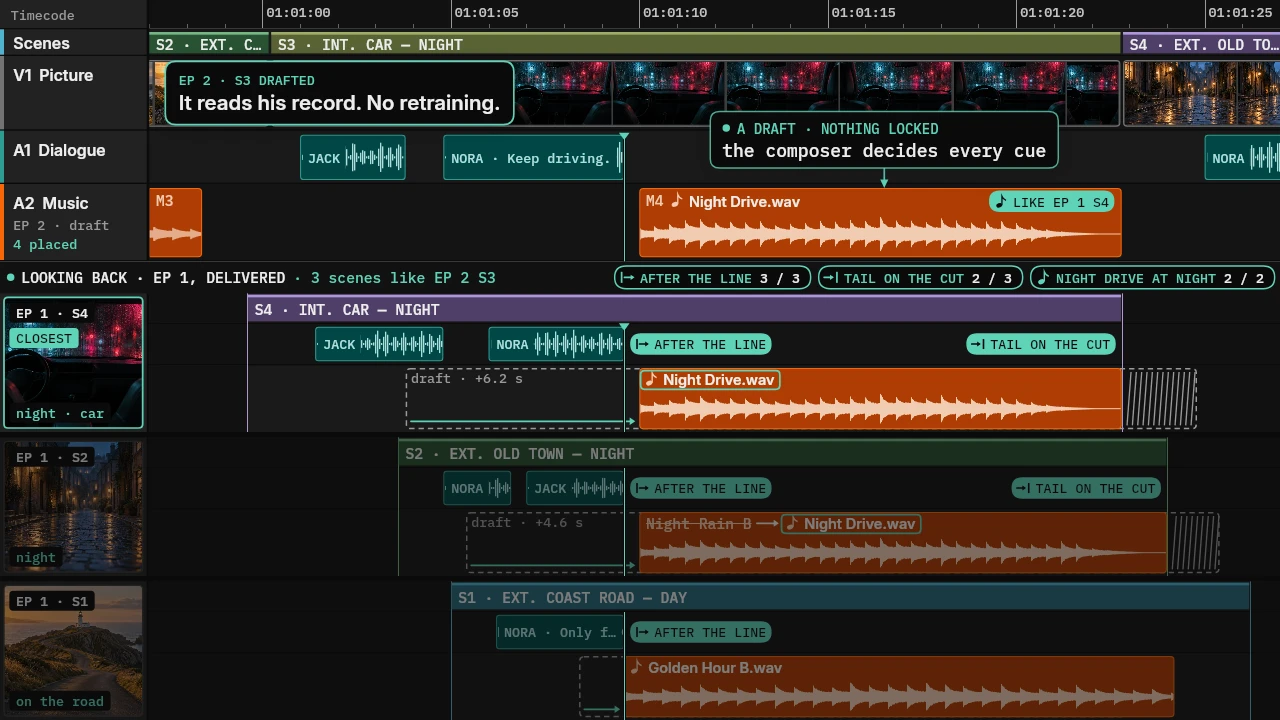
When an episode is finished, Cuepup goes back through all of it, studies every change the composer made and records it. The next episode starts with that record. The language model itself is not retrained.
80% of its songs kept in the later 16 episodes, against 64% in the first 13 420 of 528, against 286 of 450 Observed over time, not a controlled test
Music recognition
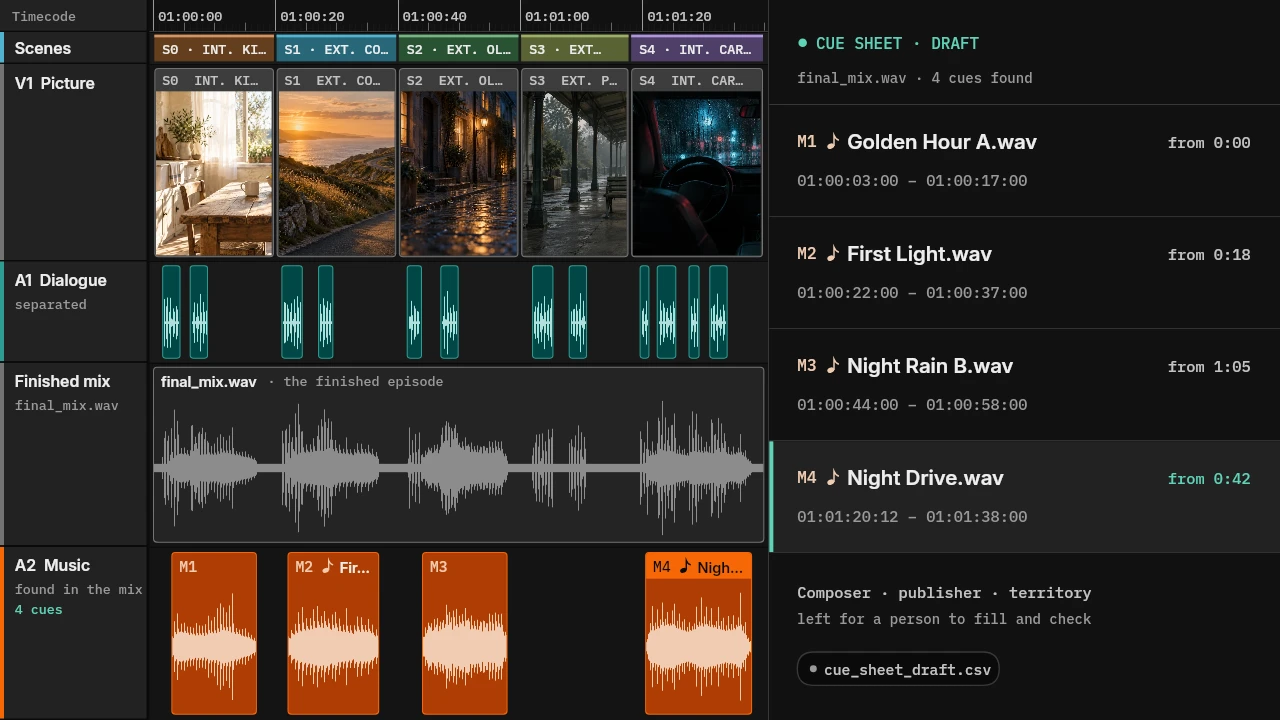
It finds library cues in the finished mix
Give Cuepup a finished episode and your music library. It finds which recordings were used, where they enter and leave, and how they were cut, including under dialogue; less reliably when the music is very quiet. A cue sheet draft comes with it, for a person to check.
99% of verifiable library cues found, none matched to the wrong song 320 of 324; 43 unverifiable cues left out; 9 extra detections 15 episodes
Lab notes
85%
of music regions kept the song Cuepup chose
208 of 244 regions; 67% left exactly as placed · latest seven episodes · 21 Oct 2026. One show and one composer; internal records, not a guarantee.
All lab notesFAQs
Does Cuepup generate music?
No. Cuepup selects recordings from the library the project supplies and edits them to picture. It never composes or generates new music.
Who makes the final decision?
The composer. Cuepup proposes where music enters and leaves and prepares an editable draft at picture timecode. The composer changes choices and timing and decides on the final mix. The project team checks music permissions.
Which AI models do you use?
Scene boundaries, speakers, story, dialogue reading and cue spotting run on Claude Opus 5.5 by Anthropic. Dialogue is transcribed with xAI’s Grok speech-to-text and a local model. Source separation, fingerprinting and music analysis run on local models in our lab. A model stays only if it holds up on our own episodes.
Does it learn my style?
It is designed to. In our tests, after each finished episode it compared its draft with what the composer kept, moved, replaced and removed, kept that record, and looked at it in similar scenes of the next episode. The language model itself is not retrained.
How long does a first draft take?
19.7 minutes for a 42-minute episode, until the editable project is ready with every song placed and cut. It is a first draft; the composer finishes the work. By hand, a 67-minute episode took our composer about 10.5 hours of work. Both measurements are in our lab notes.
How do you measure quality?
We compare drafts with the composer’s final decisions and music ID matches with the real cue sheet, episode by episode. The numbers above are internal checks on a broadcast drama we score. They guide development; they are not a guarantee on unseen material.
What does Music ID deliver?
A cue-sheet CSV, a piece list with offsets, layers and levels, a placement file for a supported audio workstation and a JSON report. Composer, publisher and territory information is not resolved automatically; a person checks and completes the report.
Can I use it today?
Not as a public product yet. Cuepup is tested in-house on our own TV work. We are looking for a few scoped pilots with TV music and post-production teams, and we agree the scope and the material before asking for anything.
Start with a conversation.
For investment, startup programmes or a scoped pilot, write to the founder. We agree the scope before asking for any material.
batuhan@cuepup.com